

ARTICLE ABOUT MARADONA VISIT
The event of the century for Bengali football fans
Guest Column : Kausik Bandyopadhyay Article Written By :Kausik BandyopadhyaySenior Lecturer in History
North Bengal University, India & Fellow
Maulana Abul Kalam Azad Institute of Asian Studies
5, Ashraf Mistri Lane
Opp. Ballygunge Military Camp
Kolkata-700019
West Bengal, India.
Associate Editor
Soccer and Society (London: Routledge)
21.11.2008 : Diego Maradona is coming to Kolkata. This is probably going to be the event of the century for Bengali football fans. But before Maradona arrives here to bewitch your senses, have a look at the man with a divine touch from his own autobiography.
Kausik Bandyopadhyay casts an eye on the man, his career and his enigmatic personality using El Diego: the autobiography of the world’s greatest footballer (London: Yellow Jersey Press, 2004) as a lens.
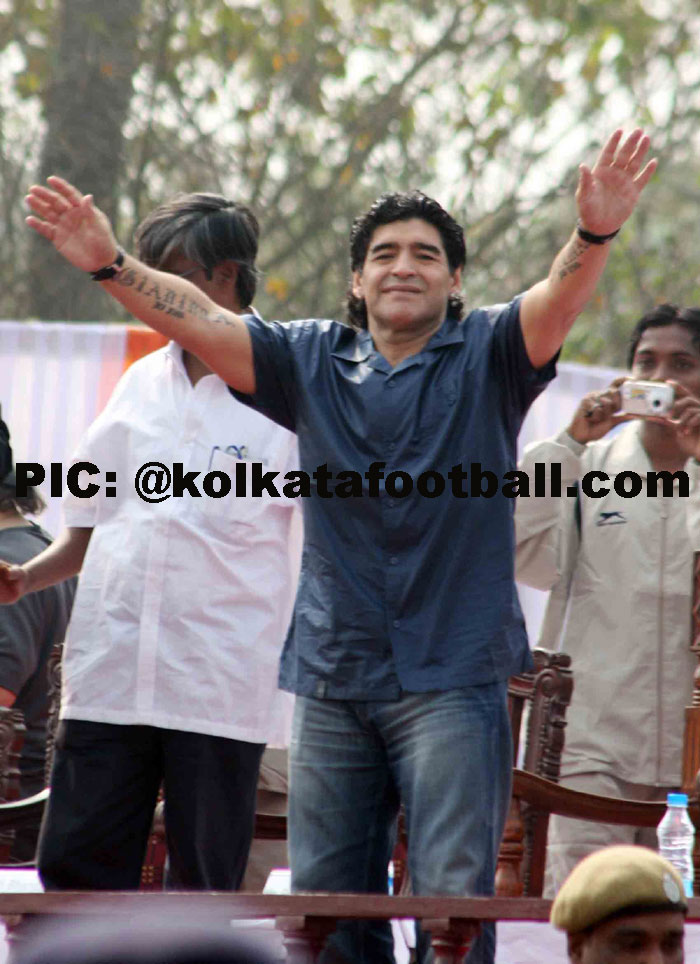
Diego Armando Maradona thrives on controversy. Despite being one of two greatest global footballing icons along with Pele, he remained a controversial figure through out his footballing career. And he remains a bone of controversy even after his retirement. A man of exceptional footballing genius Diego decided to use his famous hand of god albeit in a different way once he had kept off his shoes in 1997. This time the hand produced an emotionally charged confessional tale – a hitherto unknown Maradona known to him only. As Diego himself states: “Sometimes I think that my whole life is on film, that my whole life is in print. But it’s not like that, it’s not like that at all, there are things which are only in my heart – that no one knows. At last I have decided to tell everything.” Thus he tells the story of his extraordinarily enigmatic life from his poverty-stricken origins to his greatest glories, from the pinnacle of his footballing feats to the status of a fallen star with ‘astonishing frankness and brilliant footballing insight’. In fact, as one goes through it, one realizes that Maradona’s enthusiasm for self-revelation is no less interesting than his enthusiasm for football.
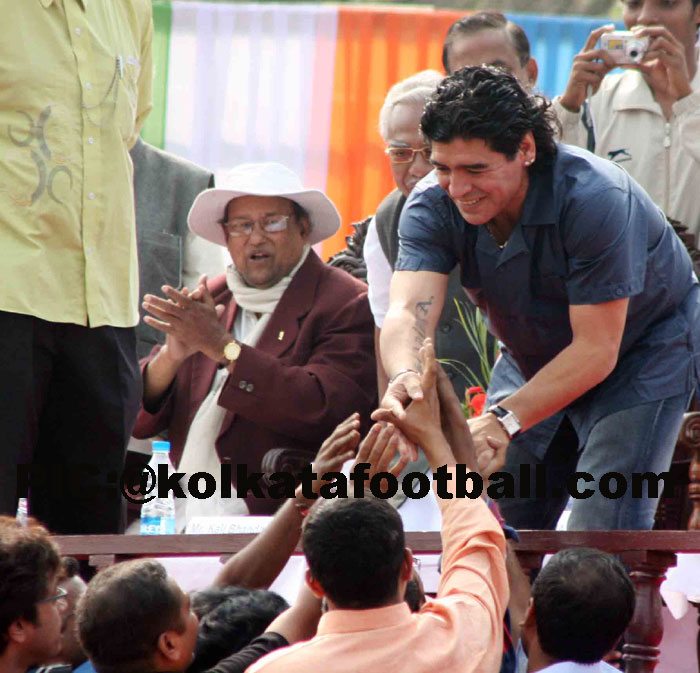
A poor boy from the shanty town of Buenos Aires Maradona was an addict to football from his childhood. The reason, as he admits, was: “playing football gave me unique peace.” Diego considered himself to be a professional footballer from the start, as he always preferred to play for the team that had picked him first. His parents, brothers and sisters – all became a source of sustenance and energy for him to play the game in true spirit from the very beginning. Watching him play for Los Cebollitas as a boy, experts and spectators could easily understand what was in the making! As the first ever newspaper report on him said that a boy had appeared “with the demeanour and class of a star”. That’s why he was asked to do tricks with the ball on a most popular TV programme in Argentina when he was only eleven.
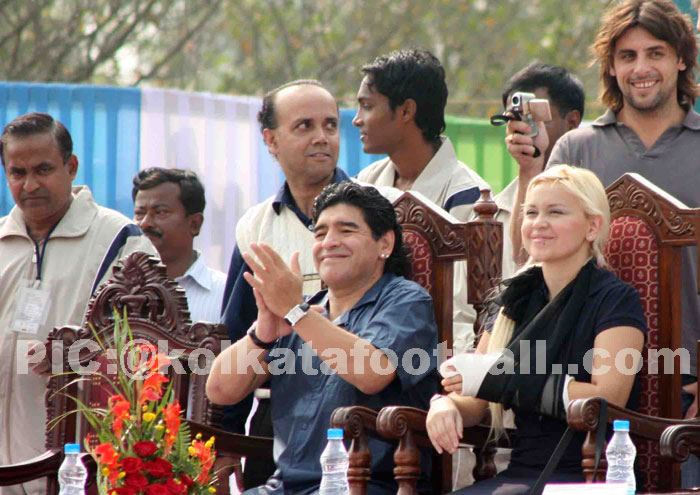
However, it was while playing for Los Cebollitas as a boy that Maradona “scored a forerunner of the other goal, the hand of God.” And when another hand goal was disallowed by a referee a few years later he thanked him and admitted that he “couldn’t promise anything” on such occasions in future. Diego’s debut with Argentinos Juniors in 1976 was the first break of his career as he began to be noticed and highlighted in national media with rapid pace. At this point he had to grow too fast as both expectation and envy urged him to grow up quickly. Come 1977, Maradona wore the national shirts for the first time in a friendly against Hungary. And the same year he found his life partner La Claudia. A coincidence for a lifetime!.
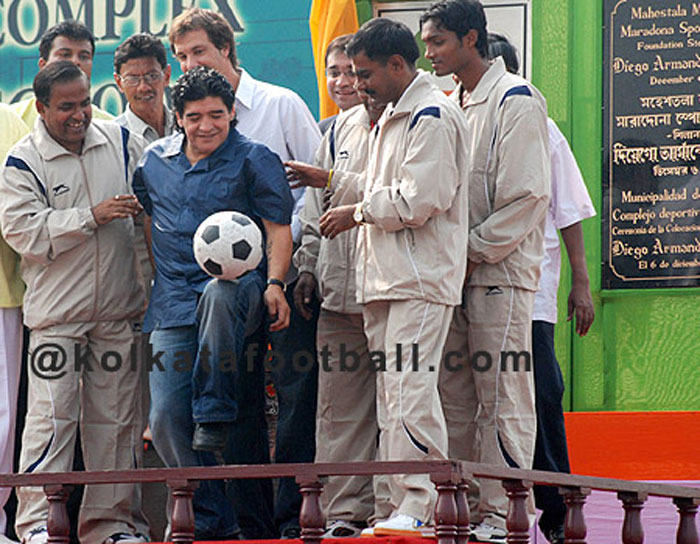
Maradona could not find a place in Argentina’s Cup winning squad of 1978. It was “the biggest disappointment “ of his life, yet “it marked me for ever, it defined me.” Anger and revengefulness – byproducts of his exit from the team – were to remain fuel for Maradona’s genius throughout his career. He always turned the table whenever he suffered a setback. That’s how he came to limelight when he blazed through his way to help Agentina win the first FIFA Coca Cola Youth World Cup in Japan in 1979. Diego left Argentinos Juniors next year to join Boca Juniors – an important step in his professional footballing career. Yet, his stint with Boca was wrought with ups and downs in performance – consistency became the catchword for him and his team. Diego began to realize another truth of his footballing life – blows and injuries.
In his first World Cup in Spain 1982 he had to negotiate with the kicks and blows from his opponent defenders. Although he and his compatriots came to the Cup tired and over-trained from concentration, most of them suffered from complacency: “We thought we were the best and we hadn’t even played a game.” Maradona played his part scoring his first goals in the biggest show, but could not check his impulses on the field. Being continually kicked by opponents every game, he finally lashed out against Brazil and got a red card. Spain was over for the last time winners, but not for Maradona as Barcelona FC had secured his transfer on the eve of the tournament for an unprecedented amount. However, it was difficult for him to cope with tricks and politicking of the club for long.
More importantly, he suffered his first major injury of his career leading to an operation on his leg and requiring a lengthy recovery programme. But his time with Barcelona was ill fated not only because of these things, but more because “there, in Barcelona, my relationship with drugs began.” Hence, the change for the better – not only for Diego but more for his new club Napoli – the club which fought hard to avoid relegation thrice in a row till 1984. And Maradona gave everything he could to Napoli – Serie A title, Copa Italia and the coveted UEFA Cup. Never before and never after the world saw such a modest team to dominate European football for so long – an unparallelled feat by Diego.
Come 1986 and Argentina under Diego’s captaincy lifted the World Cup – the most desired occasion of his life. The road to this glory Diego delineates elaborately and vividly. For the first the Cup was telecast globally and the globe had their first visual footballing icon on screen. Maradona, Burruchaga, Rugeri, Valdano and the inspiring Bilardo – a great combination saw Argentina through although after a very hard fought final against West Germany. But Mexico ’86 is remembered for one special match – Argentina’s clash with England. It not only witnessed Diego’s Hand of God shining with a goal hoodwinking the referee but produced the greatest goal in the history of World Cup – a “dream goal” in Maradona’s own words.
Maradona could not win the Copa America despite best of efforts in 1987 and 1989. Argentina finished runner up in Italia 90 thanks not only to Maradona magic but also to the genius of its reserve goalkeeper Goykochea. Yet, the world saw the severest fouls committed against one man in the tourney. Maradona also became aware of a possible Italian vendetta after Argentina knocked them out of the World Cup that summer. And he left Napoli in 1991. Post-1991 Diego’s career reveals a story of ups and downs including bans, comebacks, scandals and drug tests. Drug had already become a bane of his life – a bane from which he could never really recover in his career. Meantime, he played for Sevilla in Spain with sparks of his old form at times. And then came USA ’84 where Maradona had his swan song. Tested positive in scheduled drugs, he had to face the most shameful and painful music of his life. He was banned from football for another 15 months. Stories have multiplied about is intentions –innocent or evil, but let us hear to his voice of confession: “The truth, the only truth about the World Cup ’94 is that my personal trainer, Daniel Cerrini, made a mistake and I took the brunt of the fallout.” (p. 201) The Argentinian side – a great side that time – could not recover from the set back and went on to lose meekly to Romania in the second round.

Diego’s fight to stage a comeback with the ball, however, continued unabated although he knew that his Cup of glory was over. He found solace with his old love Boca Juniors where he remained with intermittent sparkles of his old touch. But he got tested positive again in 1997. Time was fast running out for the ‘world’s greatest footballer’ and he played his last match for Boca against Newell’s on 25 October without knowing the same. It was time for a farewell: “And I said goodbye to football. For ever? I could never say that.”
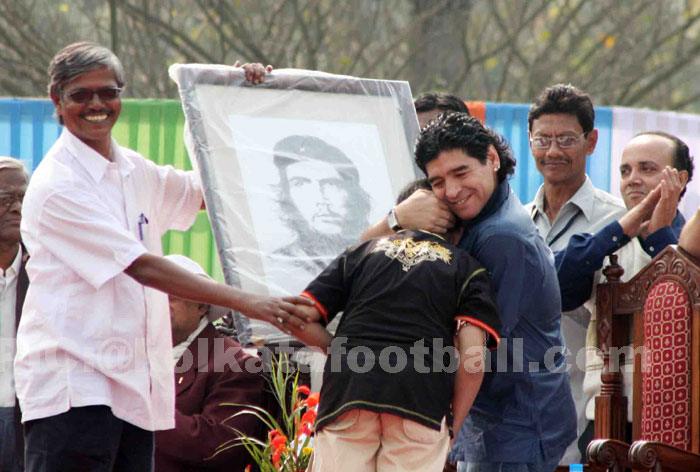
People across the world keenly awaited the English translation of Diego’s autobiography since its first publication in Spanish in 2000. The book was worth it as it reveals the true man on and off the pitch. Amazing, interesting and insightful, it’s real pleasure reading the book even for those who don’t like Maradona but love the game. Written with passion, coherence and clarity, it shows when an impulsive character reveals himself with honesty, an autobiography too can become authentic and authoritative. Maradona’s struggle with the pressures of his life on and off the pitch and his uncanny ability to turn negative feelings into positive energy and revenge into inspiration not only fascinate but inspire as well.
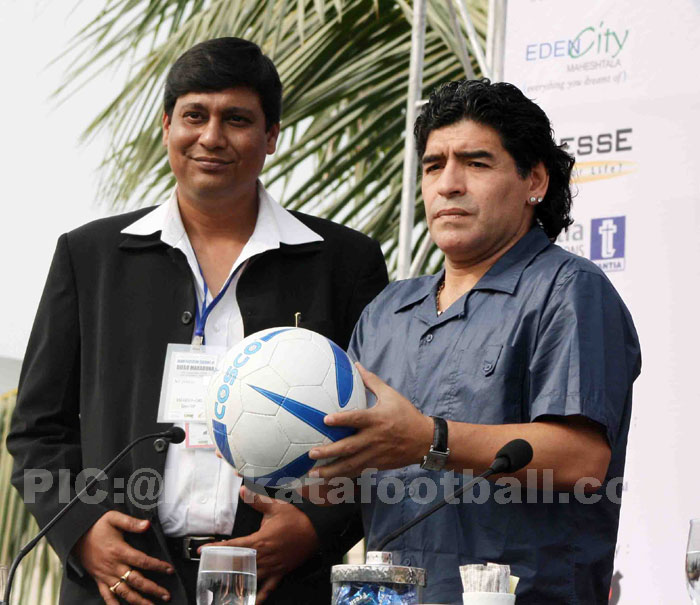
Since his (in)famous ‘hand of god’ goal against England in 1986 Maradona and controversy became synonymous as he was “torn between the demands of orporate club bosses, the fans, the media, and his own tempestuous personal life”. In the last chapter of his autobiography, Maradona talks about his most loved and dear ones in life, presents his all time favourite Argentine formation, mentions those players who have delighted him and reveals his relations with some big personalities like Fidel Castro or Carlos Menem. This chapter has hinted to many unknown aspects of his life, which, if Maradona desires to elaborate a bit later on, could produce another revealing memoir, which would, now it seems, include his visit to Kolkata as well, thereby making us proud for ever.

